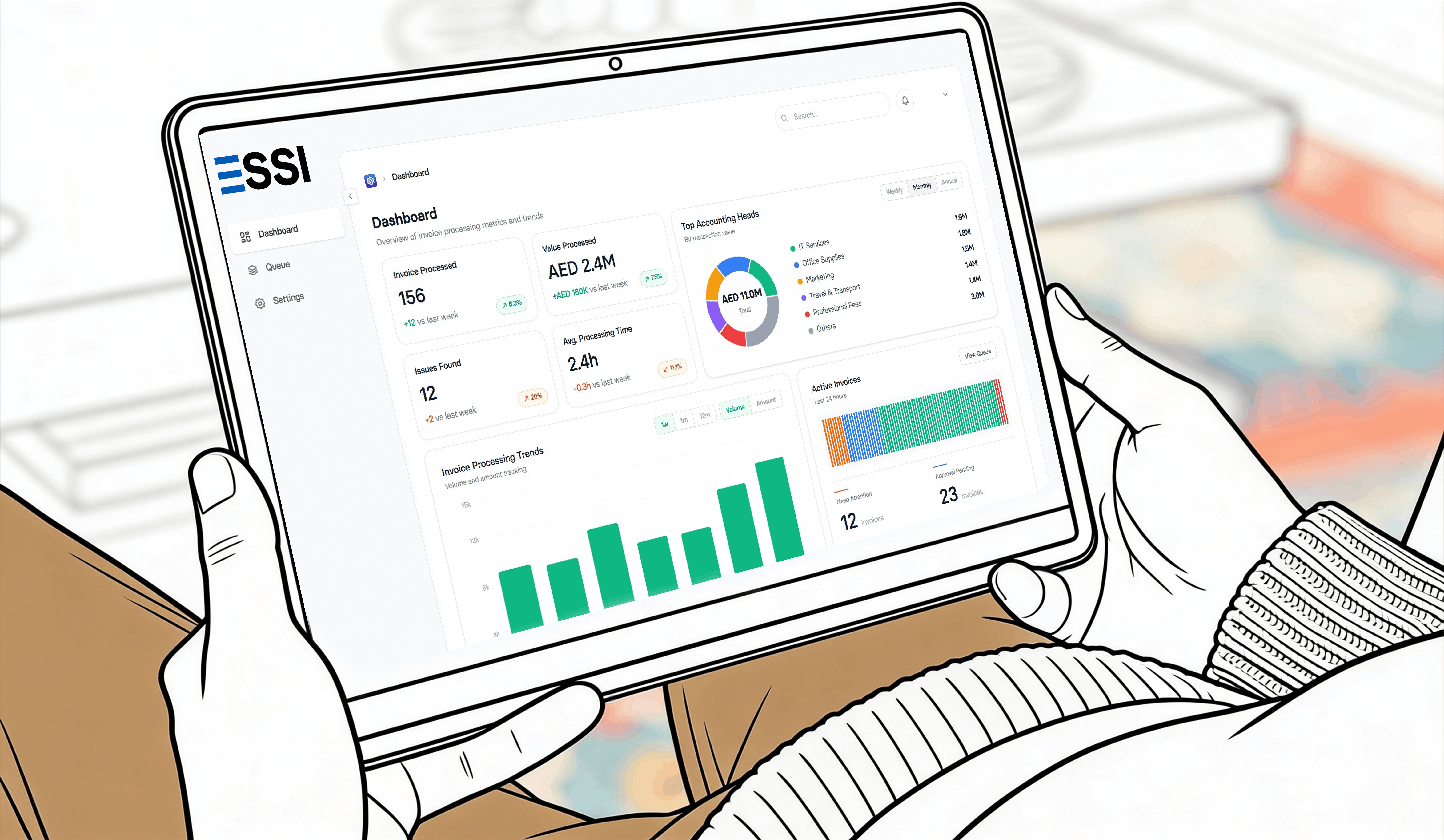



Most organizations focus their e-invoicing investment on ASP connectivity — and stop there. But moving invoices to a compliance node does nothing to fix the operational breakdowns happening upstream, inside your source systems.
When the integration stops at the compliance layer, your AP and AR teams are left absorbing the operational fallout — manually, expensively, and at scale.
This is where an e-invoice Source System Integrator (ESSI) comes in, an AI-enabled single powerful layer that transforms e-invoicing from a regulatory checkbox into a measurable office-of-finance transformation.

ESSI helps enterprises move beyond technical compliance and build a smarter, more controlled finance process around UAE e-invoicing.
As the approved provider landscape grows, businesses need flexibility. ESSI helps you avoid being tightly locked into one provider by creating a scalable integration layer between your systems and the ASP.
ESSI validates, enriches, and checks invoice data before it reaches the ASP. That means fewer errors, fewer rejections, and a better first-time-right submission rate.
ESSI does more than help move invoices. It connects AP, AR, approvals, matching, exception handling, and analytics — turning compliance into an opportunity to improve finance operations.
You do not need to disrupt your existing finance environment to become compliant. ESSI works as an intelligent layer that helps integrate with current systems in a controlled, low-friction way.
ASPs focus on compliance connectivity. ESSI handles the last-mile integration between source systems, workflows, finance teams, and the compliance rail.
ESSI helps the business gain more than compliance — with better control, reduced manual effort, improved visibility, faster processing, and stronger working capital performance.
THE TRANSFORMATION
THE ROI STORY
Operational Value, Not Just Technical ConnectivityESSI is built to deliver measurable business outcomes across the office of finance — transforming a compliance mandate into a platform for operational excellence.
Significant reduction in human touchpoints per invoice through automation and enrichment.
Higher invoice acceptance rates driven by upstream validation before the compliance node.
Fewer AP, procurement, and vendor disputes through accurate matching and clean data.
Faster approvals and settlement, improving working capital and supplier relationships.
See how ESSI can help your business achieve compliance with zero errors, lower operational friction, and more value across finance operations.

"*" indicates required fields
A : E-Invoicing is a government-mandated process or digital framework requiring businesses to issue, process, and report invoices electronically. This initiative enhances transparency, improves supply chain efficiency, and minimizes tax evasion.
Key Milestones of UAE E-Invoicing:
Mandate Effective Date: July 1, 2026
Scope of Transactions: Applies to all B2B and B2G transactions (B2C transactions are currently excluded)
E-Invoice Format: Machine-readable XML paired with a human-readable PDF
Technology Model: PEPPOL 5-Corner Model, an advanced system ensuring seamless interoperability globally between businesses, service providers, and tax authorities.
A : E-Invoicing is a government-mandated digital framework requiring businesses to issue, process, and report invoices electronically in a machine-readable format. It becomes mandatory in the UAE from 1 July 2026 for all B2B and B2G transactions.
A : All businesses operating in the UAE that engage in B2B (business-to-business) or B2G (business-to-government) transactions must comply. B2C transactions are currently excluded from the mandate.
A : UAE E-Invoices must be in a machine-readable XML format paired with a human-readable PDF. The underlying technology framework is the PEPPOL 5-Corner Model, which ensures interoperability between businesses, service providers, and tax authorities globally.
A : PEPPOL is an international standard that enables seamless electronic document exchange between businesses and government bodies across different systems and countries. The UAE has adopted the 5-Corner Model to support cross-border invoicing and global business connectivity.
A : Finesse connects your existing ERP or accounting systems to compliant e-invoicing solutions, manages mandatory registration, automates real-time invoice submission, and handles XML/PDF generation without disrupting your existing workflows. End-to-end compliance support is included.
A : The main challenges are ERP integration complexity, employee change aversion, navigating MoF and FTA compliance requirements, protecting sensitive financial data, and getting suppliers and customers to transition alongside you. Finesse's solution covers all five areas with technical integration, change management, and security built in.
A : E-Invoicing automates invoice exchange, eliminates manual data entry errors, speeds up payment cycles, reduces operational costs, and enables real-time reporting for accurate VAT filings. It also future-proofs your business for cross-border digital trade under the PEPPOL framework.
A : Finesse's e-invoicing platform includes robust data security features to protect sensitive financial information during electronic transmission, ensuring invoice integrity throughout the entire invoicing process in line with UAE regulatory requirements.
A : Yes. Finesse provides self-billing support for import transactions and automates the generation of compliant credit notes for invoice corrections, reducing manual intervention and compliance risk.
"*" indicates required fields