



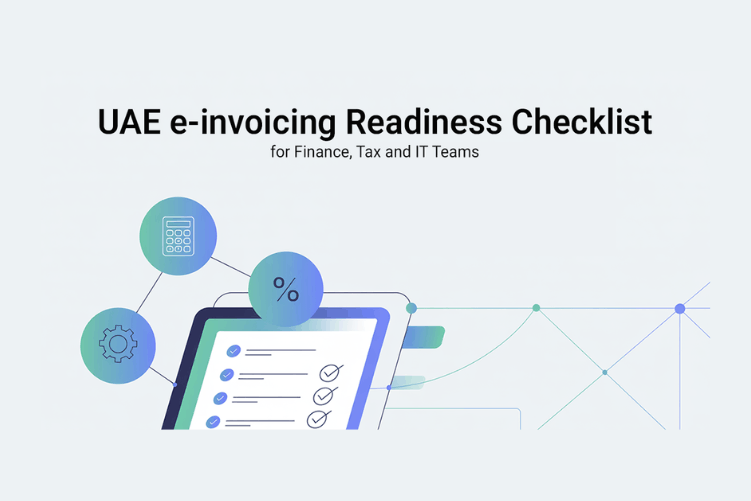
Why readiness matters
UAE e-invoicing requires more than appointing a provider. Businesses must prepare systems, data, people, workflows, and controls. A readiness checklist helps finance, tax, and IT teams work together before mandatory deadlines arrive.
The MoF guidelines include a readiness checklist covering ERP or accounting application changes, integration with ASP systems, testing, governance, and go-live readiness.
1. Confirm your scope
Start by identifying whether your business transactions are in scope. B2B, B2G, G2B, and G2G transactions are covered, while B2C transactions are currently outside the system until a future decision.
2. Check your deadline
Businesses with revenue of AED 50 million or more must appoint an Accredited Service Provider (ASP) by 31 July 2026 and implement by 1 January 2027. Businesses below AED 50 million must appoint an ASP by 31 March 2027 and implement by 1 July 2027. Government entities must implement by 1 October 2027.
3. Review ERP and accounting systems
Check whether your systems can generate all required invoice data. This includes invoice details, buyer and seller data, tax fields, document totals, and line-item information.
4. Clean master data
Customer and supplier records must be accurate. Missing TRNs, trade license details, addresses, country codes, tax categories, or payment terms can cause invoice validation problems.
5. Select and onboard with an ASP
Review the MoF’s pre-approved service provider list and assess providers based on experience, integration capability, support, security, pricing, and scalability.
6. Build integrations
ERP, accounting, procurement, AP, and AR systems should connect with ASP workflows. Middleware may be required where multiple systems are involved.
7. Test before go-live
Test different invoice scenarios, credit notes, error cases, buyer responses, and reporting confirmations.
8. Train users and define governance
Finance and IT teams should know how to handle rejected invoices, system failures, ASP issues, and data updates.
How Finesse Global can help
Finesse Global can lead e-invoicing readiness assessments, integration planning, data mapping, ASP connectivity, workflow automation, and dashboard development.
FAQs
Who should own e-invoicing readiness?
Finance, tax, IT, procurement, and operations should work together.
What is the first step?
Start with a readiness assessment covering scope, systems, data, and deadlines.
Sign up for our newsletter and get day to day updates.
"*" indicates required fields
© Copyright 2026, All Rights Reserved by FinesseDirect