



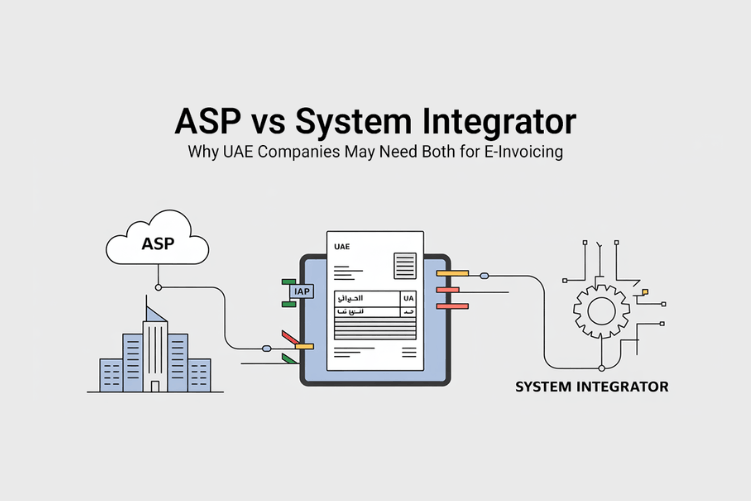
Do you only need an ASP for UAE e-invoicing?
Many businesses assume that appointing an Accredited Service Provider is enough to become e-invoicing ready. In reality, appointing an ASP is only one part of the journey. UAE e-invoicing also requires internal system readiness, invoice data quality, ERP integration, finance process alignment, and user adoption.
The MoF guidelines state that businesses should make necessary changes to their in-house enterprise solutions to be compatible with UAE Electronic Invoicing System specifications.
What does an ASP do?
An ASP supports the exchange and reporting of electronic invoices. In the UAE 5-corner model, the supplier’s ASP validates invoice data, converts it into UAE standard XML if needed, transmits the invoice to the buyer’s ASP, and reports tax data to the Federal Tax Authority.
This makes the ASP essential for compliance connectivity.
What does a system integrator do?
A system integrator focuses on your internal business environment. This includes ERP, accounting systems, procurement platforms, vendor master data, customer master data, approval workflows, AP automation, AR billing, reporting dashboards, and exception handling.
For example, if your ERP does not hold all mandatory fields, your ASP cannot magically correct your master data. If buyer information is incomplete, tax categories are wrong, or invoice workflows are manual, the business may still face operational issues. customizations to in-house systems
Section 8.3: Mandatory Electronic Invoicing – UAE e-invoicing guidelines
Chapter 9: Getting ready for Electronic Invoicing – UAE e-invoicing guidelines
Appendix 2: Electronic Invoicing readiness checklist -UAE e-invoicing guidelines
Appendix 3: Roles and responsibilities, Section 15.3: Persons and Government Entities-UAE e-invoicing guidelines
Why both roles matter
Think of the ASP as the regulated e-invoicing gateway and the system integrator as the enterprise execution partner. The ASP helps transmit and report invoices. The system integrator ensures your internal systems can generate, validate, send, receive, reconcile, and monitor invoice data properly.
This is especially important for businesses with multiple ERPs, branches, subsidiaries, free zone entities, complex VAT scenarios, or high invoice volumes.
What risks arise without integration?
Poor integration can lead to rejected invoices, manual rework, delayed payments, duplicate invoice records, compliance gaps, and finance team frustration. It can also reduce the business value of e-invoicing by treating it only as a regulatory exercise.
How Finesse Global can help
Finesse Global acts as the e-invoicing readiness, integration, and finance automation partner. Finesse can help businesses connect existing systems with ASPs, automate AP and AR workflows, create exception dashboards, and turn e-invoicing into a stronger finance control environment.
FAQs
Is Finesse Global an ASP?
Finesse should be positioned as an integration, readiness, automation, and finance transformation partner unless officially accredited as an ASP.
Why is integration important?
Because e-invoicing depends on accurate data moving from internal systems to ASP workflows without disruption.
Sign up for our newsletter and get day to day updates.
"*" indicates required fields
© Copyright 2026, All Rights Reserved by FinesseDirect